Attractions in Mahesana, Gujarat
From millennia-old temples and UNESCO-listed stepwells to sacred hills and vibrant markets — North Gujarat's most spectacular sites await your discovery.
Mahesana District — An Unrivalled Treasury of Heritage
If you were to draw a circle of 80 kilometres radius around Mahesana city and count the UNESCO-recognised heritage structures, ancient temples of national importance, historic stepwells, and significant archaeological sites within that circle, you would find yourself with a list that rivals the density of heritage in regions far more famous on the international tourism circuit. The Mahesana district is, quite simply, one of India's most underrated concentrations of historical and architectural treasure.
The primary reason for this extraordinary concentration lies in the district's history as the heartland of the Solanki (Chaulukya) dynasty, which ruled Gujarat from approximately 940 to 1244 CE and during whose rule the region experienced one of the most extraordinary periods of artistic and architectural creativity in Indian history. The Solanki kings were ambitious builders and generous patrons of the arts, and they left behind a legacy of temple architecture, stepwells, and public monuments that has never been surpassed in the region.
This page is your comprehensive guide to the key attractions in and around Mahesana — from the absolute must-sees that merit a multi-hour visit to the quieter, lesser-known gems that reward the curious traveller willing to venture a little further off the beaten path. We have organised the attractions by distance from Mahesana city to help you plan your itinerary efficiently, but we encourage you to follow your own instincts — in this part of Gujarat, there is often something remarkable just around the next corner.
Most of Mahesana's major attractions are within 50 km of the city centre. Hiring a local taxi or auto-rickshaw for a full-day tour is the most efficient option. A recommended two-day itinerary: Day 1 — Modhera Sun Temple + Unjha + Siddhpur. Day 2 — Patan's Rani ki Vav + Vadnagar + Taranga Hills.
Modhera Sun Temple — India's Most Perfect Solanki Monument

The Modhera Sun Temple stands as the most complete, best-preserved, and architecturally sophisticated monument of the Solanki period in Gujarat — and by many expert assessments, one of the finest examples of medieval Hindu temple architecture anywhere on the Indian subcontinent. Built around 1026 CE by the Solanki king Bhimdev I, the temple was designed with extraordinary astronomical intelligence: on the equinoxes, the first rays of the rising sun pass through the entrance torana and strike directly upon the image of Surya in the inner sanctum, illuminating it with a golden shaft of light that seems to animate the stone deity for a few brief, transcendent minutes.
The temple complex is structured as a procession through sacred space. Before reaching the main shrine, visitors cross the vast Ramakund — a step-tank of remarkable beauty, its terraced stone steps dotted with 108 small shrine niches containing images of the Solanki divine pantheon. The tank was designed for ritual ablution before worship and for the storage of sacred water, but its proportions and decoration are so refined that it functions equally as one of the most beautiful pieces of landscape architecture in India.

The Sabha Mandapa — the large, hypostyle assembly hall — is perhaps the most immediately overwhelming part of the complex. Fifty-two pillars, each carved with a complexity and virtuosity that defies belief, support a ceiling that is itself a marvel of geometric stone carving. Each pillar depicts scenes from the Ramayana, the Mahabharata, and the Puranas in narrative friezes that would require hours to read properly. The quality of the stone carving — so fine that the figures seem to breathe, the textiles they wear seem to rustle, the jewels they carry seem to gleam — represents the absolute apogee of Solanki artistic achievement.
The main shrine (Garbhagriha) once housed a large gold image of Surya, which was removed — along with the temple's jewels and treasures — during the raids of Mahmud of Ghazni in the early 11th century. The image was never restored, and the temple has not been used for active worship since the medieval period. This has actually worked to its preservation advantage: managed by the Archaeological Survey of India, it has been conserved with greater care than many still-active temples, and its stonework survives in remarkable condition.
The external walls of the main shrine (shikhara) are a full encyclopaedia of the Solanki artistic universe — horizontal bands of sculpture depicting apsaras (celestial dancers), gandharvas (celestial musicians), mithunas (auspicious couples), elephants, horses, and the 12 aspects of the sun god arrayed across the cardinal directions. The sheer density of imagery, combined with the exceptional quality of execution, makes the outer walls of the Modhera temple arguably the finest sculptural programme on any standing monument in India.
| Detail | Information |
|---|---|
| 📍 Location | Village Modhera, Mahesana District, Gujarat — 25 km SW of Mahesana city |
| 🕐 Opening Hours | 6:00 AM to 6:00 PM (all days) |
| 🎫 Entry Fee | ₹25 (Indians) | ₹300 (Foreign nationals) | Free for children under 15 |
| 📷 Photography | Permitted (no flash inside sabha mandapa) |
| 🎪 Best Event | Uttarardh Mahotsav Dance Festival — January (3 days) |
| ⏱️ Suggested Duration | 2–3 hours minimum |
| 🚗 How to Reach | Taxi or bus from Mahesana city; shared autos available |
Pro Tip: Arrive at Sunrise
To witness the magical solar alignment — when the first light of dawn enters the sanctum — arrive well before 7 AM on any morning from late November to mid-January. The equinox alignments in March and September are the most dramatic, but any winter sunrise at Modhera is extraordinary. The Kund reflects the warm sky beautifully in the early morning calm, before the tourist crowds arrive.
Rani ki Vav — The Queen's Stepwell & UNESCO World Heritage Site
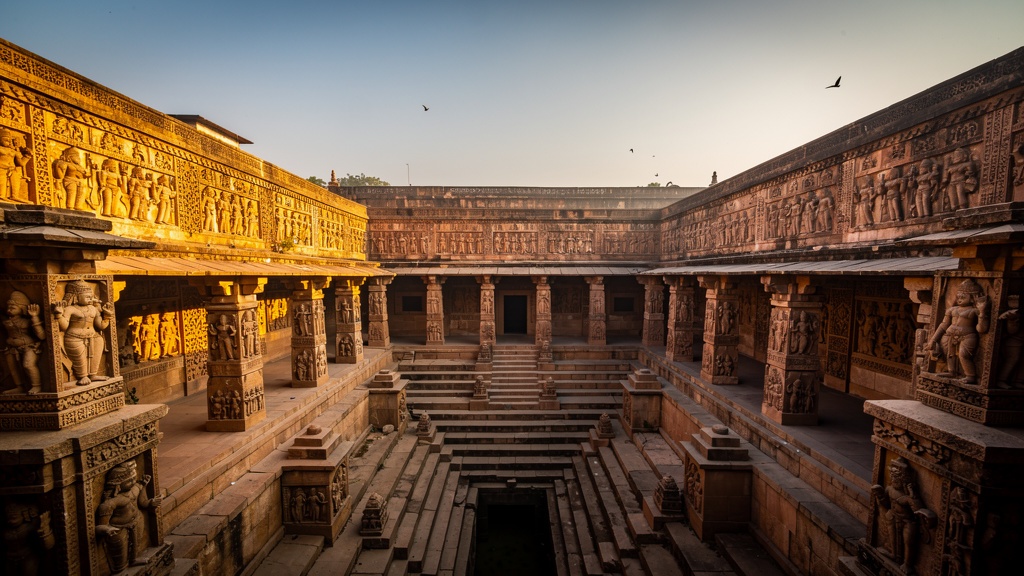
Forty kilometres west of Mahesana city lies the ancient capital of the Solanki dynasty — Patan, known in medieval times as Anhilwara Patan — and within it, one of the most extraordinary structures in all of India: Rani ki Vav, the "Queen's Stepwell." Inscribed on the UNESCO World Heritage List in 2014, Rani ki Vav is universally regarded as the finest and most elaborate stepwell (vav) ever constructed, not just in Gujarat but in the entire Indian subcontinent.
Built around 1063 CE by Queen Udayamati as a memorial to her late husband, Solanki king Bhimdev I (the same king who built the Modhera Sun Temple), Rani ki Vav is a structure of almost incomprehensible artistic ambition. Oriented east–west and descending to a depth of approximately 30 metres, the stepwell is divided into seven storeys of progressively refined carved niches, each storey featuring horizontal rows of sculpture depicting gods, goddesses, and themes from Hindu mythology.
The total number of major sculptural panels is over 800, with thousands of smaller decorative figures filling every available surface. The sculptural programme is dedicated primarily to Vishnu and his ten avatars (Dashavatara), depicted in a variety of poses with an expressiveness and technical virtuosity that has rarely been surpassed in Indian art.
The Rani ki Vav was buried under silt deposited by the Saraswati River for several centuries — a circumstance that, paradoxically, ensured the exceptional preservation of its sculptures. It was excavated and restored by the Archaeological Survey of India in the 1980s, and the quality of carving revealed was so extraordinary that it prompted the subsequent UNESCO inscription. One of the most famous sculptures at Rani ki Vav — a serene image of the Apsara admiring herself in a mirror — is considered such a masterpiece of medieval Indian sculpture that it was chosen to grace India's 100-rupee banknote.
Structurally, the stepwell served a vital civic function in the semi-arid landscape of North Gujarat, providing a reliable supply of groundwater accessible even in the driest seasons. But Rani ki Vav was designed not merely as a utilitarian water storage system — it was conceived as an underground temple, a sacred space where the act of descending toward water was invested with spiritual meaning. The deeper you descend, the more elaborate the carving becomes, the more intense the play of light and shadow, the more profound the sense of entering a different world entirely.
Location: Patan, 40 km west of Mahesana | Timings: 8:00 AM – 6:00 PM (closed Fridays) | Entry Fee: ₹40 (Indians) | ₹600 (Foreign nationals) | UNESCO Status: World Heritage Site (2014) | Tip: Visit early morning to avoid crowds and for best photography light
While in Patan, do not miss the opportunity to visit the Patan Patola Heritage Museum, where the extraordinary double-ikat silk weaving tradition of Patan — one of the most technically demanding textile arts in the world — can be observed in practice. Patola saris from Patan are among the most expensive and prized textiles produced anywhere in India, and watching the weavers at work is a lesson in the patience and mathematical genius that goes into each metre of cloth.
Vadnagar — An Ancient City of Kirti Toranas and 2,500 Years of History
Vadnagar is one of those Indian towns that carries its history with a casualness that would be astonishing if you stopped to think about it. People go about their daily business of buying vegetables and arguing about cricket while living literally on top of archaeological layers reaching back 2,500 years — layers that, when excavated, have yielded evidence of continuous urban habitation spanning the Mauryan empire, the Gupta period, the medieval Solanki dynasty, and beyond.
The most immediately arresting sight in Vadnagar is the pair of Kirti Toranas — freestanding ceremonial gateways constructed during the Solanki period, believed to date from the 11th or 12th century CE. These two soaring arches, rising to a height of approximately 13 metres and decorated with exuberant bands of carved figures, are among the finest surviving examples of the torana (gateway) tradition in Indian architecture. They stand today in a small park near the Sharmishtha Lake, somewhat incongruously surrounded by the ordinary streetscape of a modern North Gujarat town — yet their beauty is undiminished.
The Archaeological Museum at Vadnagar houses an impressive collection spanning the entire documented history of the site, from prehistoric pottery to Solanki-period bronze sculptures. Recent excavations at Vadnagar under the aegis of the Archaeological Survey of India have produced particularly exciting results, with finds including Roman-era trade goods (suggesting Vadnagar's participation in the ancient maritime trade network), Buddhist monastery remains, and a rich sequence of medieval stratigraphy.
Vadnagar is also significant as a place of Tantric and Shaivite religious tradition — the town contains several ancient Shiva temples that remain active centres of worship, and the nearby Sharmishtha Lake is associated with various local legends. The annual Kartik Purnima festival brings thousands of pilgrims to bathe in the sacred lake, transforming the usually tranquil town into a vibrant centre of religious activity.
Don't Miss: Vadnagar Museum & Sharmishtha Lake
The Archaeological Museum is open Tuesday to Sunday, 10 AM to 5 PM. The Sharmishtha Lake, adjacent to the Kirti Toranas, is a lovely spot for an evening walk and offers reflections of the toranas in its calm waters at dusk — a photograph worth planning for.
Siddhpur — The City of the Rudra Mahalaya & Matru Tarpan
Siddhpur is one of those places in India where history, faith, and architecture intersect in ways that are uniquely moving. Situated approximately 25 kilometres northwest of Mahesana, Siddhpur (historically known as Shrishthal) was once one of the great cities of medieval Gujarat, and its ruins and remaining monuments give visitors a palpable sense of its former grandeur.
The principal monument at Siddhpur is the Rudra Mahalaya — or what remains of it. Built by the Solanki king Siddhraj Jayasinh (r. 1094–1143 CE), the Rudra Mahalaya was conceived as the largest temple complex in all of Gujarat, a monument intended to surpass every previous royal commission in scale and magnificence. At its height, the complex covered an enormous area and featured multiple shrines, mandapas, and towers that would have made it one of the most impressive architectural ensembles in the medieval world.
The complex was largely demolished in the 14th century, and its stones were reused in the construction of mosques during the sultanate period. What remains today — a row of imposing columns, a partially standing torana, sections of carved wall — is both architecturally fascinating and deeply evocative. Walking through the juxtaposition of medieval Hindu pillars incorporated into later Islamic structures, you experience in microcosm the complex religious and architectural history of North Gujarat.
Siddhpur is also uniquely known across India as the place of "Matru Tarpan" — the ritual offering (tarpan) for deceased mothers. Hindu tradition holds that while tarpan for fathers is performed at the more widely known site of Gaya in Bihar, the corresponding ceremony for mothers should be performed at Siddhpur. On the occasion of Pitru Paksha (the fortnight dedicated to ancestral offerings, falling in September-October), thousands of pilgrims travel to Siddhpur from across India to perform this moving ceremony of filial devotion on the banks of the Saraswati River.
Taranga Hills — Sacred Jain Pilgrimage Centre
Rising dramatically from the flat plains of North Gujarat, the Taranga Hill complex is one of the most important Jain pilgrimage destinations in the state and a site of extraordinary natural and architectural beauty. Located approximately 55 kilometres northeast of Mahesana, Taranga is set within a range of rocky hills that take on an almost magical quality at sunset when the stone turns deep amber and the white marble of the Jain temples seems to glow against the darkening sky.
The principal shrine at Taranga is the Ajitanath Temple, dedicated to the second Jain tirthankara (saint). Built in the 12th century CE under the patronage of the Solanki king Kumarpal — who converted to Jainism under the influence of the great Jain monk Hemchandra — the temple is a masterpiece of white marble carving, with an interior that features some of the most refined decorative stonework in Gujarat. The dome of the main mandapa, supported by columns whose capitals are each uniquely and elaborately carved, is particularly stunning.
Around the main Ajitanath Temple are several smaller shrines and temples, also built in the white marble style, that together form an extended sacred precinct. The hilltop location means that the complex offers sweeping views over the surrounding plains that are particularly beautiful in the winter months, when the air is clear and the distant Aravalli hills can be seen glinting on the horizon.
The ascent to the Taranga temples can be made either on foot (via a well-maintained stone path of about 2 km) or by local transport to the base, followed by a shorter walk. The pilgrimage season sees the greatest activity around the Jain calendar festivals of Paryushana and Mahavir Jayanti, but the site is rewarding to visit year-round. The surrounding hills also offer opportunities for light trekking and nature walks, with the scrub forest harbouring peacocks, langurs, and a variety of migratory birds in the winter months.
Unjha — The Umiya Mata Temple & Spice Capital of North Gujarat
The town of Unjha, situated just 20 kilometres north of Mahesana, occupies a dual identity that makes it unusually interesting for the curious traveller. It is simultaneously one of the most important pilgrimage centres for the Kadva Patidar community — whose patron deity Umiya Mata has her principal temple here — and one of the most significant spice and agricultural commodity trading hubs in North Gujarat, famous across India for its fennel (saunf), cumin, and medicinal herb markets.
The Umiya Mata Temple at Unjha is a significant and active place of pilgrimage that draws hundreds of thousands of devotees annually, particularly during the Navratri festival and on auspicious Tuesdays. The current temple complex, while not ancient in the architectural sense, is an impressive and beautifully maintained example of modern Gujarati temple building tradition, with an inner sanctum housing a revered image of the goddess Umiya that has been worshipped at this site for many centuries.
The agricultural market (mandi) at Unjha is equally worth experiencing — particularly for travellers interested in India's extraordinary agricultural economy and commodity culture. The morning hours (roughly 8 AM to noon) see a flurry of activity as farmers bring produce to sell, traders negotiate prices in a specialised argot of hand signals and whispered numbers, and the air fills with the clean, sharp scent of fennel and cumin. This sensory experience — the colours of the spice sacks, the sounds of trading, the fragrance of fresh produce — is quintessentially North Gujarati and remarkably photogenic.
Dudhsagar Dairy — A Modern Wonder of Cooperative Economics
Not all of Mahesana's attractions are ancient — and the Dudhsagar Dairy is proof that the district's capacity to produce extraordinary things extends into the modern era as well. Founded in 1960 under the banner of the Mehsana District Cooperative Milk Producers' Union (MDCMPUL), the Dudhsagar Dairy has grown to become one of the largest dairy processing facilities in Asia, processing millions of litres of milk daily and producing a range of dairy products — butter, ghee, skimmed milk powder, flavoured milk, paneer, and ice cream — that are distributed across India under the beloved "Dudhsagar" brand.
The story of Dudhsagar Dairy is inseparable from the larger story of "Operation Flood" — India's White Revolution, led by the legendary cooperative visionary Dr. Verghese Kurien — which transformed India from a milk-deficient nation into the world's largest milk producer within a generation. The Mahesana district, with its large population of Patidar farmers with deep traditions of cattle-rearing, was one of the early and most successful participants in this cooperative model, and the Dudhsagar Dairy stands as a tangible monument to what organised cooperative economics can achieve.
For visitors, the dairy offers guided tours by prior arrangement that explain the cooperative model and the milk processing operations. The dairy's retail outlet, located on the main plant premises, is an excellent place to purchase fresh Gujarati dairy products — the Dudhsagar butter and ghee in particular are considered benchmark products by connoisseurs of Indian dairy. The ice cream is also exceptional, made from high-quality fresh milk with flavours that reflect local Gujarati taste preferences.
Location: Dudhsagar Road, Mahesana city | Tours: By prior arrangement with management | Retail Shop: Open daily | Best Buy: Fresh ghee, butter, paneer, and Dudhsagar ice cream
All Mahesana Attractions at a Glance
| Attraction | Distance | Type | Entry Fee | Best Season |
|---|---|---|---|---|
| Modhera Sun Temple | 25 km SW | Heritage Temple | ₹25 / ₹300 | Oct – Mar |
| Rani ki Vav, Patan | 40 km W | UNESCO Stepwell | ₹40 / ₹600 | Oct – Mar |
| Vadnagar | 30 km NE | Historic Town | Museum: ₹10 | Year-round |
| Siddhpur | 25 km NW | Temple Ruins | Free | Sep – Mar |
| Taranga Hills | 55 km NE | Jain Temples | Free | Oct – Mar |
| Unjha Temple & Market | 20 km N | Temple / Market | Free | Year-round |
| Dudhsagar Dairy | In city | Modern Heritage | Free (tour: arrangement) | Year-round |